Knowing Your Customer
A customer calls in and you recognize the name and you know they run a fleet of D39s and a PC210. You know they prefer texts over phone calls. You know they're price-sensitive on wear items but want overnight shipping on anything hydraulic because downtime costs them more than freight. None of that is in any system; you learned it by paying attention.
That kind of knowledge is what turns a competent PCR into the person a customer asks for by name.
Why Customer Knowledge Matters at the Counter
Your tools and platforms tell you what part fits what machine. They don't tell you how your customer thinks, what they care about, or how they like to work with you. That layer of knowledge is something only you can build, and it's the thing that separates your dealership from an online parts catalog.
When you know your customer:
- You stop asking questions they've already answered. A customer who has to re-explain their fleet, their preferences, or their situation every time they call will eventually stop calling you and find someone who remembers.
- You catch things they wouldn't think to mention. If you know a customer has three WA380s and they're ordering GET for one, you can ask about the other two. This is not upselling, it's knowing their operation well enough to anticipate what they need.
- You make faster decisions on their behalf. When a regular customer calls and you already know their shipping preference, their pricing tier, and their typical order patterns, the transaction moves faster for both of you.
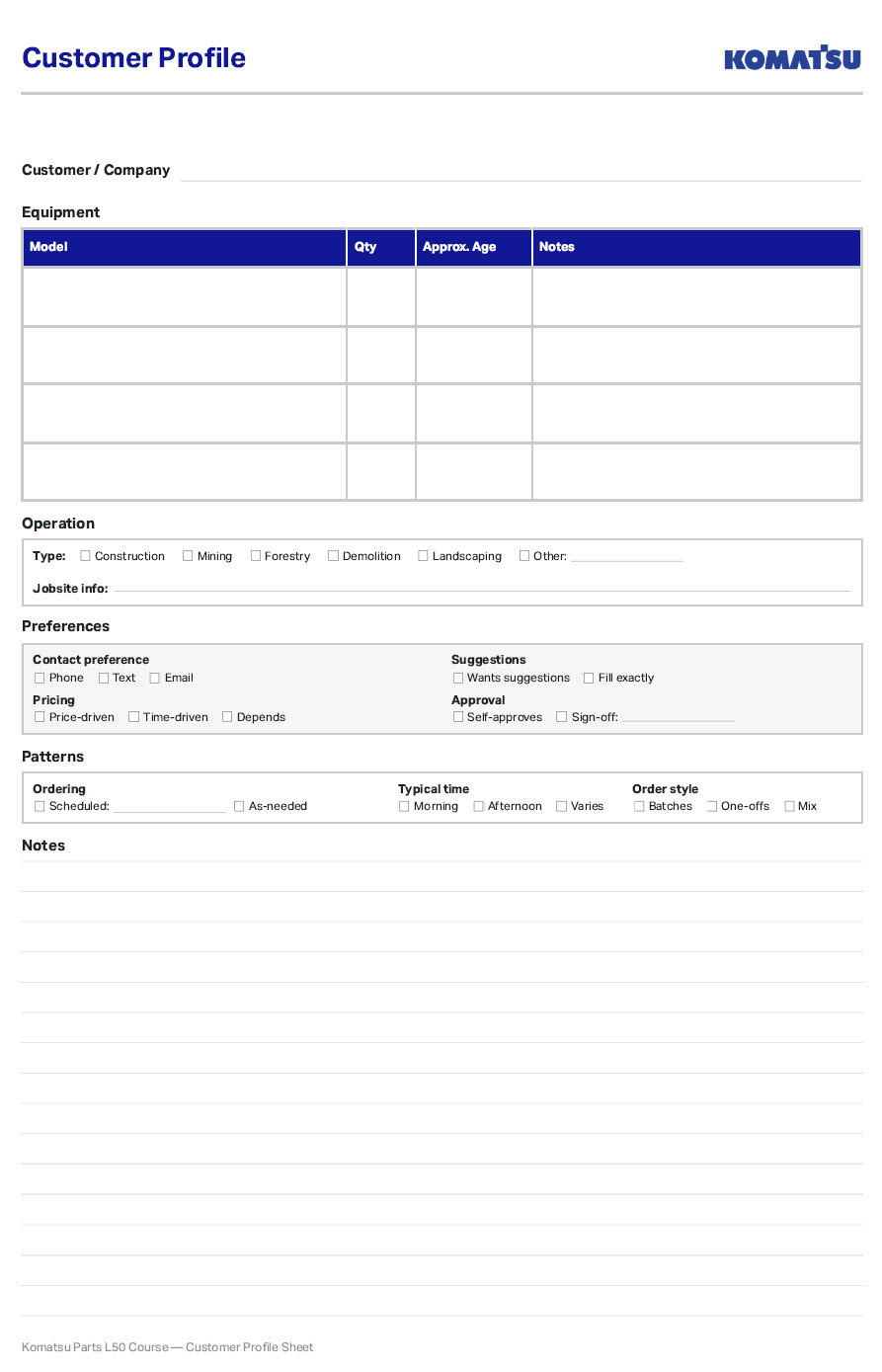
What to Learn About Your Customers
You won't know everything about a customer from the first call. But over time, paying attention to a few key areas builds a picture that makes every future interaction smoother.
How You Learn This
You don't sit a customer down and interview them. You learn it the same way you build any relationship: by paying attention during the interactions you have with them every day.
- Ask the right questions during natural moments. When a customer calls for a part, you're already asking for model and serial number. That's your opening: "Want me to check availability on the filters while I'm in here?" "Should I text you the tracking, or do you prefer email?" Each question teaches you something and serves the customer at the same time.
- Write it down. Memory isn't enough when you're handling dozens of customers a week. Whether it's a notebook, a spreadsheet, or notes in your system, capture what you learn. The information is only valuable if you can access it quickly the next time that customer calls.
- Share what you learn with your team. If you're out sick, the knowledge you've built helps your teammates serve those customers well. It also means the customer doesn't have to start from scratch with someone new.
Customer knowledge that lives only in your head is fragile; customer knowledge that's written down and shared is an asset for the whole counter.
Download this Customer Profile Sheet and start building your customer profiles:
 Download the PDF
Reflect
You've been helping a new customer for about a month now. They run a small excavation company with two PC138s and a D51. They've called four times: twice for filters, once for a set of teeth, and once for a hydraulic hose. Each time, the conversation has been friendly but transactional. They tell you what they need, you look it up, they pay and hang up.
What would you want to know about this customer that you don't know yet, and how would you find out without making it feel like an interrogation?
Start with what their ordering pattern is already telling you: they have a small fleet, they're doing their own maintenance and replacement, and they're calling as needs come up rather than planning ahead.
Questions to work into future calls naturally:
"Do you want me to set up a reminder when your filters are due again so you don't have to think about it?" This helps you learn their maintenance cycle and whether they'd value proactive outreach.
"Should I text you the tracking info, or would you rather I email it?" This teaches you their contact preference.
"Are your D51 and PCs all at the same site, or are you running multiple jobs?" This helps you learn their operation scope; single site means one delivery point, multiple sites means you need to think about delivery logistics.
Each question serves the customer in the moment while teaching you something about how they operate. Over a few calls, you'll build a picture that lets you anticipate their needs ahead of time.
Next, we'll put it all together: follow-up discipline, customer knowledge, and the skills from Module 3 all combine to make you the person your customer calls first because you make it easy.