Listen Before You Act
A long-time customer calls the service manager because his excavator has been down for six days waiting on a part. He was originally told three days and his crew is still sitting idle, and he's losing money every hour.
When the service manager picks up the phone, what do you think his first natural instincts are? Likely to defend the timeline, explain the backorder, and match the customer's energy with his own frustration about the situation.
Every one of those instincts makes the situation worse. This lesson is about what to do instead so your customer feels supported, even if you can't change the outcome.
Why Listening Is the Job
Every role at a dealership runs on information moving accurately between people, and successful outcomes depend on what gets heard, not just what gets said.
But hearing accurately, especially when the conversation is tense, fast, or high-stakes, doesn't happen by default:
Focus ➔ Filter ➔ Feedback
In a hard conversation, our natural instincts are unreliable. Focus ➔ Filter ➔ Feedback is a circuit breaker: three deliberate stages that override those instincts and keep the conversation productive:
Advance through the slides to learn what do do in each stage:
When This Is Hardest
None of this is difficult to understand, but it's especially difficult to do in the moments when it matters most:
- When you're tired, slammed, and behind on your day
- When the other person is being unreasonable, rude, or factually wrong
- When you're already in conflict with this person from yesterday
- When you have your own pressure stacked on top of theirs
This framework is especially critical for the conversations where everything in you says to react, but the cost of reacting is a lot higher than the cost of pausing.
The impulse to defend, explain, or fix is actually your cue. When you feel it, start at Focus. Stop what you're doing, face the person, and let them finish. You don't need to remember all three stages in the moment, just the first one. Focus leads to Filter, and Filter leads to Feedback.
Self-Assessment [Your Eyes Only]
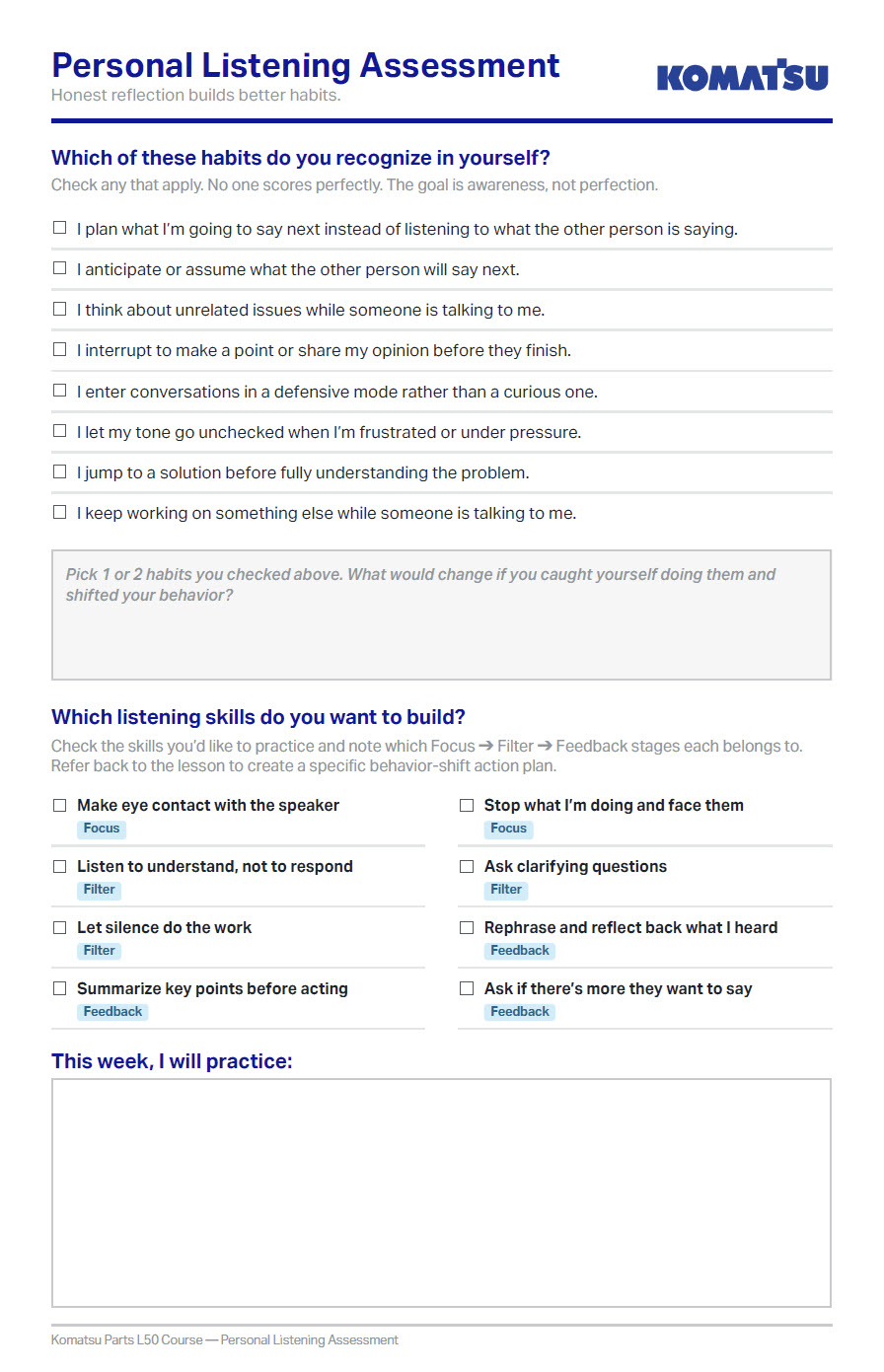
Download the self-assessment below. It takes two minutes: check the listening habits you recognize in yourself and pick one or two to work on this week.
Reflect
Think about a recent conversation at work or in your personal life where your first instinct made the situation worse. Maybe you got defensive, jumped to a solution too fast, or cut someone off because you thought you already knew what they were going to say.
If you could replay that conversation using
Focus ➔ Filter ➔ Feedback
what would you do differently at each stage?
Most people can identify a moment when their natural instincts took over. The framework doesn’t ask you to be perfect in the moment, it just asks you to pause before you react.
Focus: were you actually present, or were you already somewhere else mentally?
Filter: were you listening to understand, or listening to reply?
Feedback: did you confirm what you heard before you acted?
Even applying one of the three stages can change the outcome of a conversation. The goal is to build the habit of checking your instincts before they drive a conversation somewhere expensive.
The next lesson builds on this: once you've heard someone clearly, how do you communicate your response in a way that's clear, complete, and reaches the right person at the right time?