Close the Loop
You listened to the customer, understood what they needed, and now you have information that needs to move. How you deliver that information matters as much as the information itself.
A complete update delivered to the right person through the right channel at the right time closes the loop and builds trust.
An incomplete update leaves the loop open, which can create uncertainty and erode trust.
Four Questions Before You Communicate
Every time you need to send an update to a customer, a coworker, a supervisor, or another department, run through these four questions. They take seconds, and they prevent the kind of miscommunication that takes hours or days to clean up.
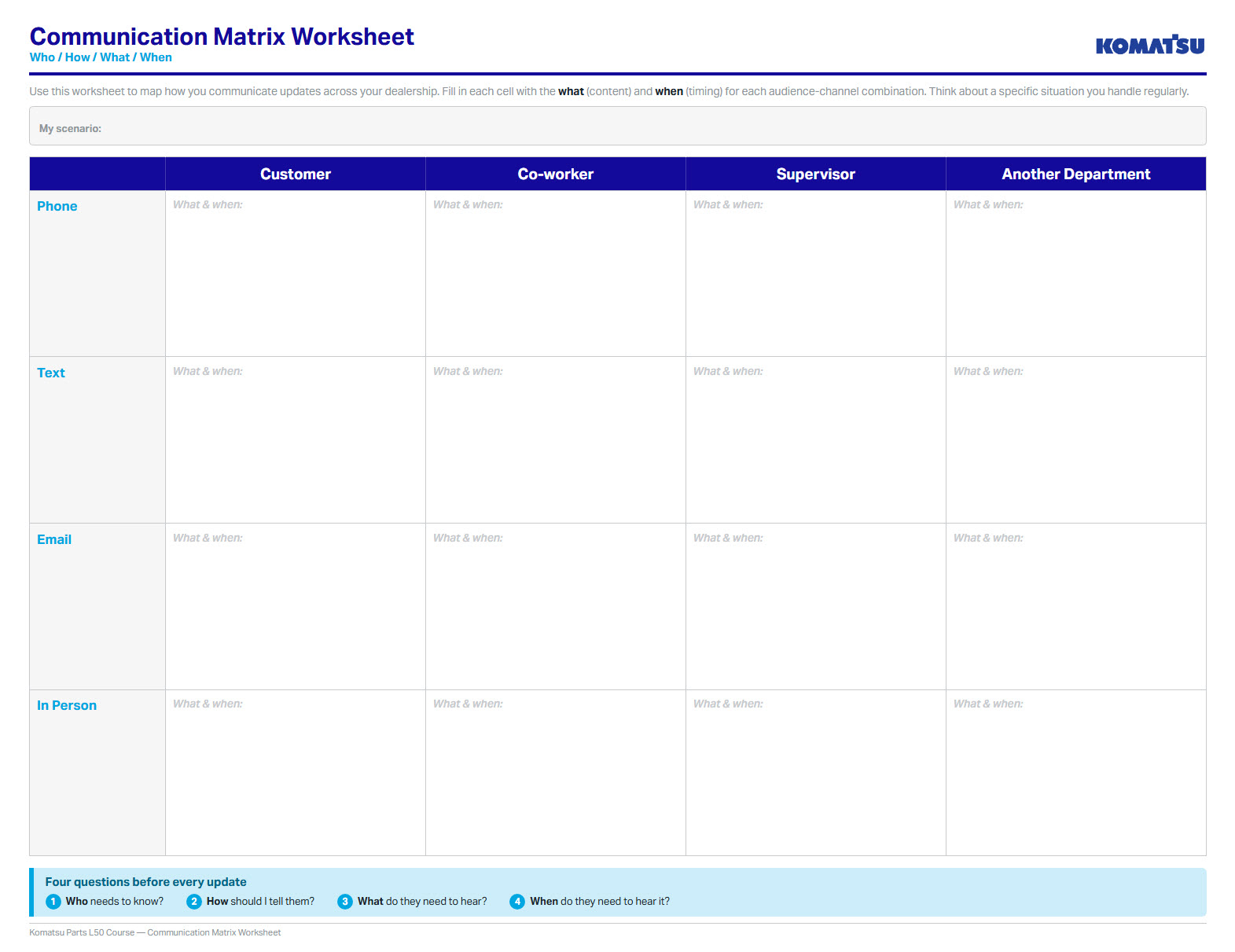
Communication Matrix Worksheet
Download the worksheet below and fill it in for a situation you handle regularly in your role. For each audience and channel, write down what you'd communicate and when. The goal is to build your own reliable reference for how updates should be communicated from your role.
Closing the Loop
Communication isn't finished until the receiver has what they need to act, and you know they have it.
Three habits separate reliable communicators from everyone else:
- Confirm receipt on critical updates. Don't assume a voicemail or email was received, check.
- Send the "resolved" message. When an issue closes, let everyone involved know. Without that closure, people keep checking on something that's already handled.
- Document what was agreed. After a phone call where decisions were made, send a short follow-up email summarizing what was decided. This protects both sides and prevents "I thought you said Thursday" conversations.
This connects directly to the Feedback stage from the last lesson. Closing the loop on a conversation and closing the loop on an email communication are the same discipline at different scales.
When the Stakes Go Up
Most communication will feel routine. Some situations demand a different level of urgency: a machine down with the customer losing money by the hour, a critical part delivery delayed, a safety issue discovered during a repair, or a commitment that can't be met.
In these moments, the four questions still apply, but the answers shift.
- Who expands: supervisor, customer, affected department all need to know.
- How shifts: pick the fastest, most direct channel.
- What gets more precise.
- When becomes right now.
Reflect
Think about a time you were waiting on information from someone and you had to chase them for an update. How did that experience change the way you felt about working with them?
Now think about what it would have taken for them to close the loop proactively, and how that would have changed how you felt.
In most cases, the information eventually arrived and the failure wasn’t in the content, it was in the timing or the initiative. They waited for you to ask instead of telling you proactively. Or they told you part of the story but left out what it meant for you or what happened next.
The gap between “they told me” and “I had to ask” is the difference between a relationship that builds trust and one that slowly erodes it. When you’re the one sending the update, asking “would this person have to chase me for this?” is a reliable gut check.
The next lesson narrows the focus to one specific dimension of communication: speed. At the parts counter, urgency is the difference between a customer's crew working tomorrow or sitting idle.